


People have been asking how and why the Middle East conflict affects mortgage rates in New Zealand, and so we have drafted this quick summary.
There is no question now that the conflict in the Middle East is putting upward pressure on mortgage rates, but there is a great deal of uncertainty around how much rates will rise in the next few months, or if they will drop back.
It seems to be universally agreed by most economic commentators that interest rates are going to increase in 2026. The question is therefore not if interest rates will increase, but when will they increase?
Swap Rates Influence Longer-Term Fixed Rates
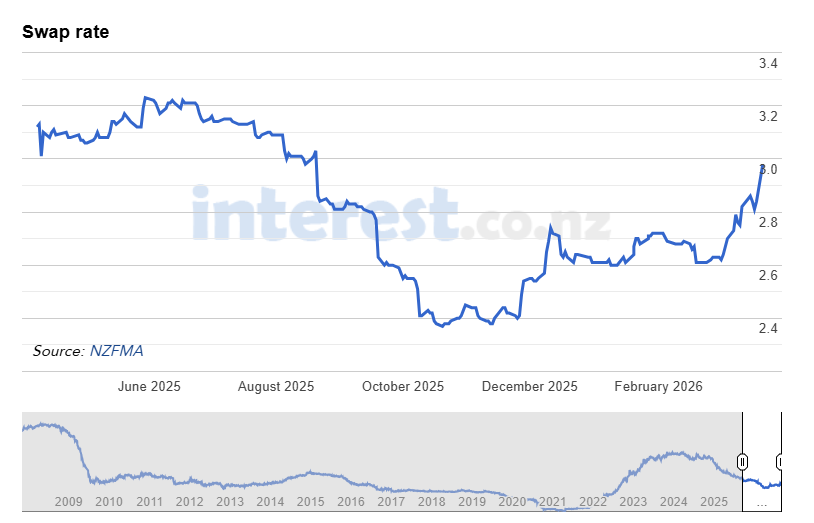
Swap rates (wholesale interest rates), which influence longer-term mortgage rates, have been rising since the conflict in the Middle East started. Swap rates can be volatile, but we have seen a sharp increase since early March.
The two-year swap rate rose to above 3.5% on Friday, after falling to a trough of 2.9% in late February after the Reserve Bank delivered a dovish pre-war Monetary Policy Statement that suggested it was less worried about inflationary pressures than the market expected it to be.
What About Home Loan Interest Rates?
So what does this mean for interest rates?
When the banks set the home loan rates they do so based on the cost of the funds, and this includes:
- Official Cash Rate (OCR): when the Reserve Bank (RBNZ) raises the OCR the banks typically raise the floating home loan interest rates and when it drops, these rates generally decrease.
- Cost of Funds: As banks borrow money from depositors (savings/term deposits) the cost of acquiring this money dictates the interest rate they must charge. Most banks in New Zealand use
- Wholesale Rates: for longer term fixed rate home loans the banks generally look at the international wholesale market, which reflect future expectations rather than just current costs.

While the OCR affects the floating rates and depositors affect short-term fixed rates, the two-year swap rates impact on what we pay for longer term fixed rates.
The Reserve Bank and most economists have been predicting that there will not be any significant interest rate increases in 2026, but things can happen that are out of our control – like the Middle East conflict affects mortgage rates in New Zealand.
Should we be concerned?
A lot of people are asking what is likely to happen over the next few months and the answer is nobody really knows.
Here at Mortgage Managers we monitor these things and have been working with lots of clients on refixing home loans. For some time now rather than focusing on the short-term refixes that have been promoted by many of the banks and other mortgage advisors, the recommendation is to set goals and establish or go back to your strategy and refix at least some of your mortgage for longer periods.
This advice remains relevant now as the Middle East conflict affects mortgage rates in New Zealand.
Remember that fixed rates are lower than floating rates and the longer term fixed rates give you some certainty. If you’re risk adverse, then fixing some of your mortgage for five years is a pretty good option. It gives you some certainty around rates for a decent length of time, and if you retain some of your mortgage on the one and two-year rates, you therefore have flexibility as well.
Offsets are becoming a lot more popular. Whereas previously a lot of people used revolving credit loans (like a large overdraft) now more people are moving to an offset loan, which enables you to link multiple bank accounts to your mortgage to offset the interest. It’s a clever way to manage your money better, and gives you some really good savings if managed properly.
Unfortunately, not all banks offer an offset home loan, but it’s certainly something that you should consider if you’re looking to refix.
Increase your repayments too improve your financial position.
When choosing your home loan an issue that is often overlooked is the ability and the impact of paying extra on your fixed loans. Most banks allow you to pay more than the minimum repayment on your fixed loan, with some banks enabling up to 20% more, whereas other banks it might be a fixed dollar amount.
It’s important that you understand what options your bank give you, but also you need to manage the risks associated with paying extra. For example, if you pay extra on an ANZ home loan, you will be shortening the loan term, which all sounds good until interest rates increase. ANZ do not automatically let you revert to the original loan term, and therefore, if interest rates increase, you can get stung with increased repayments that could easily be unaffordable. If you have an ANZ home loan, then you need to talk to your mortgage advisor about how to structure it so that you can take advantage of the extra that you can pay without getting yourself trapped when interest rates do increase.

You Can Review Today
Let’s round this off by saying, we know the Middle East conflict affects mortgage rates in New Zealand, and while we hope that this will end soon, there will be future things that affect our economy and interest rates too. As always we’re recommending that you establish or revert to a good mortgage strategy.
That should include having some flexibility in your loan by using a revolving credit or offset account, and then splitting your home loan, potentially with some over the longer five-year period, to give you that extra certainty.
It’s important that you understand what flexibility you have within your fixed home loans and try to round your payments up a bit, remembering that every extra dollar that you pay on your home loan goes straight off the principal. It means you can save a lot of money in the long run. It’s definitely something worth doing, especially while interest rates are at the current levels.
It’s always harder to pay extra on your home loan when the interest rates increase so try to make the most of the low rates that we have now.
If you have any other short’s term debt, then have a look at that and see whether that can be refinanced into the mortgage to get the lower interest rates. But try not to extend the term that you’re paying it off over.
Also, if your equity in the property is under 20%, then set yourself a goal to try and get 20% equity in your property so that you can take advantage of the special rates on offer.
The team at Mortgage Managers know the Middle East conflict affects mortgage rates in New Zealand, and that can add concern and financial pressure to Kiwis. It’s always important to establish goals, and events like this remind us that good mortgage strategies really do help keep things stable here too.

You can be assured that Kiwi Edition is constantly watching what happens in the New Zealand financial markets and we will report any changes as we see things happen – so bookmark this and pop back from time to time.